CNS Geiger Counter Program
BRINGING NUCLEAR SCIENCE INTO THE CLASSROOM
Turn invisible radiation into measurable, real-time data.
The CNS Geiger Counter Program puts a classroom-safe digitial detector and ready-made experiments in teachers’ hands – replacing fear and misconceptions with curiosity
01 – THE INSTRUMENT
What is it, and how it works
A geiger counter detects ionizing radiation – the tiny energetic particles and waves that come from natural sources all around us, in the ground, the air, our food, and even from space.
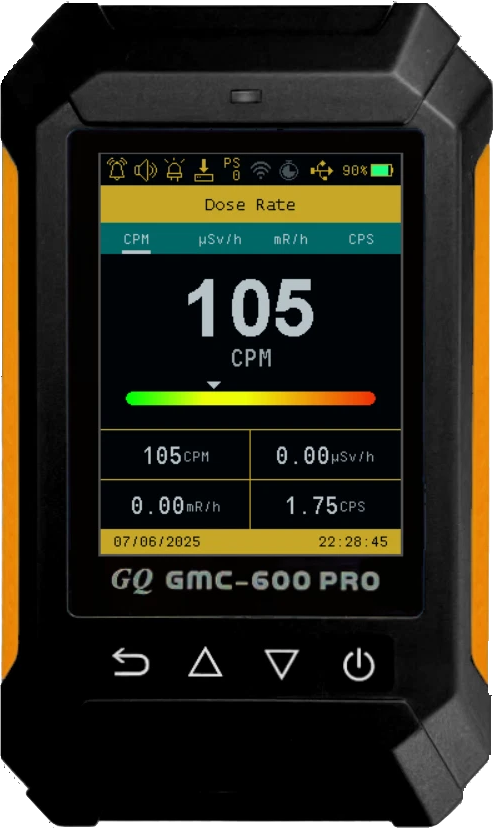
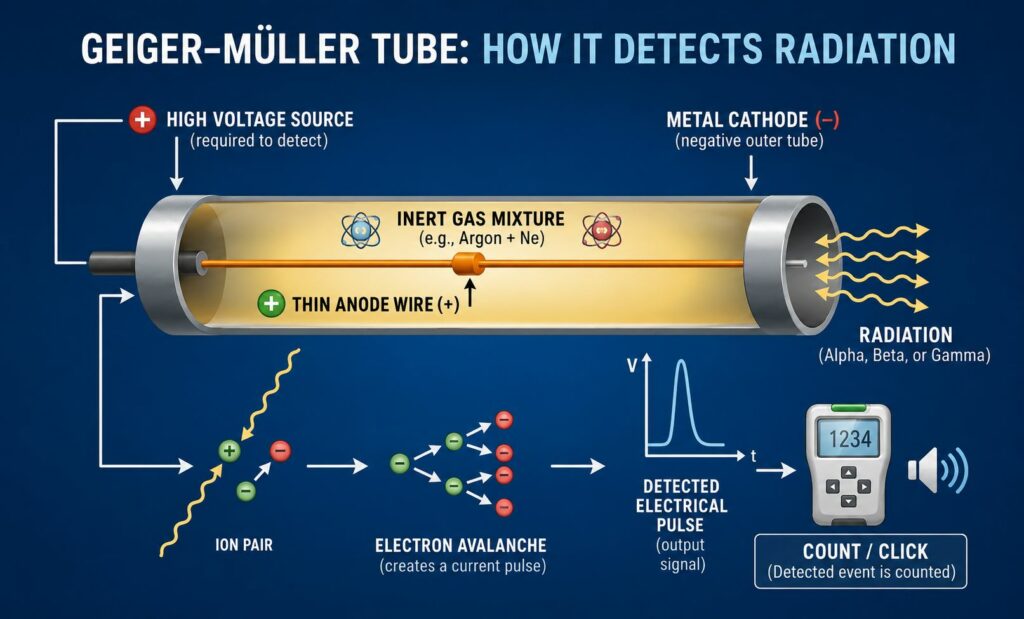
The CNS program uses the GQ GMC-600 series, a classroom-safe digital Geiger-Müller detector. Inside is a Geiger-Müller tube – a small chamber filled with gas. When a particle of raidiation enters the tube:
- It ionizes the gas, knocking electrons loose
- The device detects the resulting electrial pulse
- The counter records it as a “click,” or a count
Students can watch the number change in real time, or connect the device to a laptop to view live graphs. The display shows three readouts.
- CPS – Counts per second
- CPM – Counter per minute
- Dose Rate – µSv/h
|
Term |
Plain-language meaning |
|---|---|
|
Ionizing radiation |
Energetic particles or waves with enough energy to knock electrons loose |
|
CPM |
Counts per minute, or how often the detector registers a radiation |
|
Dose (mSv) |
A measure of radiation energy absorbed by the body, used to compare |
|
Background radiation |
The natural radiation always present from the ground, air, food, and |
|
Half-life |
The time it takes for half of a radioactive sample to decay |
|
Shielding |
A material that blocks or reduces radiation passing through it |
02 – FIVE CLASSROOM EXPERIMENTS
Try It: simple, safe experiments
All activities use naturally ocurring, low-level sources safe for classroom use. Full step-by-step instructions live in the educator guide.
EXPERIMENT 01
Measure background radiation
Record CPM over time to see that radiationis always present and that the numbers always fluctuate statistically
EXPERIMENT 02
Compare different Materials
Test granite, KCI salt substitute, and ceramic glaze to see how geology and everyday objects affect readings
EXPERIMENT 03
Shielding experiment
Place paper, foil, and plastic between the source and detector to see how alpha, beta and gamma differ
EXPERIMENT 04
Distance and intensity
Measure CPM at increasing distances to explore the inverse-square relationship in action
EXPERIMENT 05
Live graphing on a laptop
Connect the counter to a laptop and watch the distance change a real-time graph instantly
03 – FOR TEACHERS
Get a kit, get support
Everything a teacher needs to bring a kit into their classroom – requesting one, troubleshooting it, and fitting it into a course
Educators interested in participating in the CNS Geiger Counter Program can request a Geiger counter and access the Educator Guide by contacting the Canadian Nuclear Society.
To learn more or request a Geiger counter for your classroom, please email: ecc@cns-snc.ca
Get a kit
The CNS has donated Geiger kits to 272 science teachers at Canadian high schools, from St. John’s, NL, to Victoria, BC
Kit & safety FAQ
Troubleshooting, source materials (like Nu-salt and KCI), and notes on older kits built for older windows laptops
GQ Electronics Product Page
GMC-600 Manual
Curriculum fit
|
Experiment |
Subject fit |
|
Background Radiation |
Physics, Data analysis |
|
Material Comparison |
Chemistry, earth science |
|
Shielding |
Physics |
04 – REFERENCE LIBRARY
Fact Sheets, tools and further reading
FACT SHEETS
Educational Brochures
Natural Background Radiation Fact Sheet (CNSC)
Health Canada — Understanding Radiation
Radiation Safety Institute of Canada — FAQ
VIDEOS
Ionising Radiation Workshop
CNS IRW YouTube channel
Half-life of barium-137 (Frostbite Theater)
Half-life of barium-137 (Frostbite Theater)
Cosmic Watch muon detectors